Ana Sayfa |

18 Mart 2008 Salı

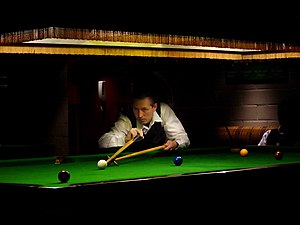
Snooker


Snooker is a cue sport that is played on a large baize-covered table with pockets in each of the four corners and in the middle of each of the long side cushions. A regulation (full-size) table is 12 ft × 6 ft (3.6 m x 1.8 m). It is played using a cue, one white ball (the cue ball), 15 red balls (worth 1 point each) and 6 balls of different colours (worth 2–7 points each).[1] A player (or team) wins a frame (individual game) of snooker by scoring more points than the opponent(s), using the cue ball to pot the red and coloured balls. A player wins a match when he wins a certain number of frames, e.g a first to five match would be called a 'best of nine', because that would be the maximum number frames to be possibly played.
Snooker is particularly popular in many of the English-speaking and Commonwealth countries,[2] and in China,[3] with the top professional players attaining multi-million pound career earnings from the game.
The history and origins of the game of snooker are generally regarded as being in the latter half of the 19th century.[5] Billiards had been a popular activity amongst British Army officers stationed in India, and variations on the more traditional billiard games were devised. One variation, devised in the officers' mess in Jabalpur during 1874 [6] or 1875,[5] was to add coloured balls in addition to the reds and black which were used for pyramid pool and life pool.[7] The word "snooker" also has military origins, being a slang term for first year cadets or inexperienced personnel.[5] One version of events states that Colonel Sir Neville Chamberlain of the Devonshire regiment was playing this new game when his opponent failed to pot a ball and Chamberlain called him a "snooker".[7] It thus became attached to the billiards game now bearing its name as inexperienced players were labelled as snookers.[8]
The game of snooker grew in the latter half of the 19th century and the early 20th century, and by 1927 the first World Snooker Championship[5] had been organised by Joe Davis who, as a professional English billiards and snooker player, moved the game from a pastime activity into a more professional sphere.[9] Joe Davis won every world championship until 1946 when he retired. The game went into a decline through the 1950s and 1960s with little interest generated outside of those who played. Things saw some improvement when in 1969 the BBC commissioned the snooker tournament Pot Black to demonstrate the potential of colour television, with the green table and multi-coloured balls being ideal for showing off the advantages of colour broadcasting.[10] The TV series became a ratings success and was for a time the second most popular show on BBC Two.[11] Interest in the game increased and the 1978 World Championship was the first to be fully televised.[12] [2] The game quickly became a mainstream sport[13] in the UK, Ireland and much of the Commonwealth and has enjoyed much success in the last 30 years, with most of the ranking tournaments being televised. In recent years the loss of tobacco sponsorship has led to a decrease in the number of professional tournaments, although some new sponsors have been sourced[14] and the popularity of the game in the Far East and China, with emerging talents such as Ding Junhui and more established players such as Marco Fu boding well for the future of the sport in that part of the world.

28 Şubat 2008 Perşembe

Rafting


Rafting or whitewater rafting is a recreational activity utilizing a raft to navigate a river or other bodies of water. This is usually done on whitewater or different degrees of rough water, in order to thrill and excite the raft passengers. The development of this activity as a leisure sport has become popular since the mid 1970s.

Rafting is one of the earliest means of transportation, used as a means for shipping people, hunting, and transferring food.
In 1842, Lieutenant John Fremont of the U.S. Army first journalized his rafting expedition on the Platte River. Horace H. Day designed the equipment he used in rafting. Day’s rafts were constructed from four independent rubber cloth tubes and wrap-around floor. [1]
In 1960s, rafting was then recognized and paths like Grand Canyon were routed and whitewater rafting companies were established.
In 1970s, rafting marked its major development as a leisure sport when it was then included in the Munich Olympic Games.
In 1980s, as rafting continued to gain its popularity, many rivers were opened for rafting activities including rivers in South America and Africa.
In 1990s, rafting was included in major game events like the Barcelona Games in 1992, Atlanta Games in 1996, and the whitewater events of the Summer Olympic Games hosted by Ocoee River in Tennessee Valley. In addition, the International Federation of Rafting was instituted in 1997 and in 1999 the first Official International Championship was held.
Currently, river rafting is still gaining popularity among extreme water sports in order to thrill and excite the raft passengers

Handball


Handball (also known as team handball, field handball, European handball, or Olympic handball) is a team sport where two teams of seven players each (six players and a goalkeeper) pass and bounce a ball trying to throw it in the goal of the opposing team.
The game has a goal similar to but smaller than the one in association football, though as the name implies, the basic method of handling the ball involves the players' hands rather than their feet. The game has been played internationally since the 1920s.
Team handball has origins reaching as far as antiquity: urania in ancient Greece, harpaston in ancient Rome, fangballspiel in medieval Germany, etc. There are also records of handball-like games in medieval France, and among the Inuit in Greenland, in the Middle Ages, and in Ancient Africa, primarily Egypt. By the 19th century, there existed similar games of haandbold from Denmark, hazena in Bohemia and Slovakia, gandbol in Ukraine, torball in Germany, as well as versions in Ireland and Uruguay.
The team handball game as we know it today was formed by the end of the 19th century in northern Europe, primarily Denmark, Germany, Norway and Sweden. The Dane Holger Nielsen drew up the rules for modern handball (håndbold) in 1898 (and published them in 1906), and R.N. Ernst did something similar in 1897.
Another set of team handball rules was published on 29 October 1917 by Max Heiser, Karl Schelenz and Erich Konigh from Germany. After 1919 these rules were further improved by Karl Schelenz. The first international games were played under these rules, between Germany and Belgium for men in 1925 and between Germany and Austria for women in 1930.
In 1926, the Congress of the International Amateur Athletics Federation nominated a committee to draw up international rules for field handball. The International Amateur Handball Federation was formed in 1928. The International Handball Federation was formed later in 1946
Men's field handball was played at the 1936 Summer Olympics in Berlin at the special request of Adolf Hitler[citation needed]. It was removed from the list of sports, to return as team handball in 1972 for the 1972 Summer Olympics in Munich. Women's team handball was added as an Olympic discipline at the 1976 Summer Olympics.
The International Handball Federation organized the Men's World Championships in 1938 and every four (or sometimes three years) from World War II to 1995. Since the 1995 World Championship in Iceland, the competition has been held every two years. The Women's World Championships have been played since 1957. The IHF also organizes Women's and Men's Junior World Championships.
As of February 2007, the IHF lists 159 member federations which represent approximately 1,130,000 teams and a total of 31 million players, trainers, officials and referees
A standard match duration consists of two periods of 30 minutes each during which each team may call one time-out. Normal league games are usually allowed to end in a draw, but in knockout tournaments, such as the of the Olympics, two extension periods of 5 minutes are played, and if they also end in a draw another two times 5 minutes has to be played. If each of these ends in a tie after the extra time the winner is determined by an individual shootout from the 7-meter line, where each team is given five shots. The rules of the shootout are similar to soccer shootouts, where, if a winner is not found within the first ten shots, the players return to the shooting, until one team has missed and the other scored. In two Olympic Finals of women's handball penalty shootout had to be used - both of them with Denmark participating (against Hungary in 1996 and South Korea in 2004); and both of them with Denmark as the winner.
The game is quite fast and includes body contact as the defenders try to stop the attackers from approaching the goal. Only frontal contact by the defenders is allowed; when a defender stops an attacker with his or her arms instead of his or her torso, the play is stopped and restarted from the spot of the infraction or on the nine meter line, with the attacking team in possession.

Typical scene in a handball game
The usual formations of the defense are the so-called 6-0, when all the defense players are within the 6 meter and 9 meter lines; the 5-1, when one of the players cruises outside the 9 meter perimeter, usually targeting the center forwards; and the least common 4-2 when there are two such defenders. The usual attacking formation includes two wingmen, a center-left and a center-right which usually excel at high jumps and shooting over the defenders, and two centers, one of which tends to intermingle with the defense (also known as the pivot or try line player, somewhat similar to the hole set (2-meter) in water polo), disrupting the defense formation, and the other being the playmaker (similar to basketball and tennis). Also the players may use the "box plus one" defense in which the players line up in a box form and the extra player will attack the other team's player who has the ball while the others guard the goal area and try to intercept passes. The formations vary greatly from country to country. The most common formation for the central European teams as well as the Scandinavian teams is 6-0. This formation can be altered to 5-1 by placing a player--usually the far wing--in the middle in front of the 9-meter perimeter to disturb the play of the other team. The Ukrainian team "HC Motor Zaporyshe" plays a 3-3 formations with man marking all over their defensive area. This formation is used by teams outside Eastern Europe only when behind with a few goals with a few minutes left, in the attempt to steal the ball faster.
Goals are much more common in handball than in most other sports; usually, both teams score at least 20 goals each, and it is not uncommon to have a match end (say) 33-31. This was not true in the earliest days, when the scores were more akin to that of ice hockey, but as offensive play (in particular in terms of counterattacks after a failed attack from the other team) has improved, more and more goals have been scored after each match.

Snowboard


A snowboard is a thin, hourglass shaped board ridden down a sloped section of earth covered in snow. It is often thought of as the winter equivalent of a surfboard or skateboard, except that the rider's feet are bound to the board via bindings. Snowboards generally have a length between 140-165cm and a width between 24 and 27 cm. The size variants are to accommodate the many varieties of people, skill levels, snow types, and riding styles that exist within the activity known as snowboarding. Snowboards are usually constructed with a laminated wood core sandwiched between multiple layers of fiberglass. The bottom or 'base' of the snowboard is generally made of various constructions of plastic, and is surrounded by a thin strip of steel, know as the 'edge'. The top layer, where a printed graphic usually resides, is usually made of Acrylic.
Types of boards

Snowbird ski resort to allow snowboards
Snowboards come in several different styles, depending on the type of riding intended:
Racing/Alpine: long, narrow, rigid, and directional shape. Best during machine groomed slopes. Most often ridden with a "hard" boot, but also ridden recreationally with soft boots, particularly by riders in Europe.
Freeride: longer in length, and semi-directional. Moderate to stiff in flex. Used for long, fast turns in various types of snow from groomed hard-pack to soft powder.
Freestyle: Generally shorter in length with a Semi-directional or twin-tip shape. Incorporates a deep sidecut for quick/tight turning. Used in the pipe and in the park on various jumps and terrain features including boxes, rails, and tables.
Freestyle (rails): flexible and short, twin-directional, wider stance, with the edges filed dull. Used for skateboard-park like snowboard parks.
All-Mountain: A hybrid between freeride and freestyle boards. The 'jack of all trades, master of none.'
Swallow-Tail: Generally a wider board that has a split running down its tail. The split tail is designed to sink the tail lower than the nose. This is preferred in powder/backcountry conditions. This is a niche board for use in powder.
Split: Not to be confused with the swallow-tail, the split board consists of a stable powder board that can be broken down into two touring skis, used when hiking in deep backcountry conditions.
Magne-Traction: The edges of the board have a wavy sidecut, with seven contact points. If the outer two contact points lose grip then the inner contact points can take over, allowing better control and edge hold, even on ice.
Snowboards are generally constructed of a hardwood core which is sandwiched between multiple layers or fiberglass. Some snowboards incorporate the use of more exotic materials such as Carbon Fiber, Kevlar, Aluminum (as a a honeycomb core structure), and have even incorporated Piezo dampeners. The front (or "nose,") of the board is upturned to help the board glide over uneven snow. The back (or "tail") of the board is also upturned to enable backwards (or "switch") riding. The base (the side of the board which contacts the ground) is made of Polyethylene plastic. The two major types of base construction are Extruded and Sintered. An extruded base is a basic, low-maintenance design which basically consists of the plastic base material melted into its form. A sintered base uses the same material as an Extruded base, but first grinds the material into a powder, then, using heat and pressure, molds the material into its desired form. a Sintered base is generally softer than its extruded counterpart, but has a porous structure which enables it to absorb wax. This wax absorption (along with a properly done 'hot wax'), greatly reduces surface friction between the base and the snow. Snowboards with sintered bases are much faster, but require semi-regular maintenance and are easier to damage. The bottom-edges of the snowboard are fitted with a thin strip of steel, just a couple of millimeters wide. This steel edge allows the board to grab or 'dig in' to hard snow and ice (like the blade of an ice skate), and also protects the boards internal structure. The top of the board is typically a layer of acrylic with some form of graphic designed to attract attention, showcase artwork, or serve the purpose similar to that of any other form of printed media. Flite Snowboards, an early and often underquoted designer, pressed the first closed-molded boards from a garage in Newport, RI in the mid 1980's. Snowboard topsheet graphics can be a highly personal statement and many riders spend many hours customizing the look of their boards. The top of some boards may even include thin inlays with other materials, and some are made entirely of epoxy-impregnated wood. The base of the board may also feature graphics, often designed in a manner to make the board's manufacturer recognizable in photos.
See also: Board Construction
Snowboard designs differ primarily in:
Length - Boards for children are as short as 90 centimeters; boards for racers, or "alpine" riders, are as long as 215 cm. Most people ride boards in the 140-165 cm range. It is a myth that the height of the rider solely dictates the length of the snowboard. Rather, the length of a snowboard corresponds mainly to the style, weight, and preference of the rider. A good rule of thumb is to stay within the recommended manufacturer weight range. The longer the board, the more stable it is at high speed, but it is also a bit tougher to maneuver. Another factor riders consider when selecting a snowboard is the type of riding it will be used for, freestyle boards being shorter than all-mountain boards.
Width - The width is typically measured at the waist of the board, since the nose and tail width varies with the sidecut and taper. Freestyle boards are up to 28 cm wide, to assist with balance. Alpine boards are typically 18-21 cm wide, although they can be as narrow as 15 cm. Most folks ride boards in the 24-25 cm range. Riders with larger feet (US size 10+) may have problems with narrower boards, as they have substantially less surface area along the edges. As a result, a rider's toes and/or heels may extend over the edge of the board, and interfere with the board's ability to make turns once it is set on edge, or 'get hung up on the snow.' This is called toe/heel-drag, and can be cured by either choosing a wider board (26cm or more), adjusting the stance angle, or a combination of the two.
Sidecut - The edges of the board are symmetrically curved concavely, so that the width at the tip and tail is greater than the center. This curve aids turning and affects the board's handling. The curve has a radius that might be a short as 5 meters on a child's board or as large as 17 meters on a racer's board. Most boards use a sidecut radius between 8-9 meters. Shorter sidecut radii (tighter turns) are generally used for halfpipe riding while longer sidecut radii (wider turns) are used for freeride/alpine/racing riding. One new development in sidecuts was the introduction of Magne-Traction by Mervin, which owns: Lib Tech, GNU, and Roxy. Magne-Traction incorporates seven bumps on each side of the board which LibTech speculates will improve edge holding.
Flex - The flexibility of a snowboard affects its handling and typically varies with the rider's weight. Usually a harder flex makes turning harder while a softer flex makes the board less stable at high speed. There is no standard way to quantify snowboard stiffness, but novices and boarders who mostly do rails tend to prefer softer flex, racers stiffer flex, and everyone else something in between.
Tail/nose width - Many freestyle boards have equal nose/tail specs for equal performance either direction. Freeride and alpine boards, however, have a directional shape with a wider and longer nose. Boards designed for powder conditions exaggerate the differences even more for more flotation on the powder.

Squash


Squash is an indoor racquet sport that was formerly called "Squash racquets," a reference to the "squashable" soft ball used in the game (compared with the harder ball used in its parent game Racquets (or rackets; see below)). The game is played by two players (or four players for doubles) with 'standard' rackets in a four-walled court with a small, hollow rubber ball. Squash is characterized as a "high-impact" exercise that can place strain on the joints, notably the knees.
The court size was codified in the 1920s at 975 cm (32 feet) and 640 cm (21 feet) wide. The front wall has a 'front wall line' 457 cm (15 feet) above the floor, connected by a raking 'front' line meeting the 'out' line on the back wall at 213 cm (7 feet) above the floor. The front wall also has a 'service line' whose top is 183 cm (6 feet) above the floor with the 'board' (the equivalent of a net) 48 cm (18.9 inches) high. The floor is marked with a transverse 'half-court' line and further divided into two rear 'quarter courts' and two 'service boxes', as shown in the diagram above.
The traditional 'American' court for the USA game, (now referred to as 'hardball squash') is a similar size, but narrower at 18 feet 6 inches (564 cm). The floor and wall markings differ slightly from the 'International' court and the tin is lower, at 15 inches (38 cm) high. However, hardball squash was replaced by softball in America as the standard version of squash and has since almost completely died out.
A 'Converted Court' is the result of converting racquetball courts to squash. Racquetball courts are 20 feet (610 cm) wide and 40 feet (1220 cm) in length, so it is relatively easy to install a back wall, producing a squash court of 20 feet (610 cm) wide by 32 feet (975 cm) long.

Badminton

Badminton is a racquet sport played by either two opposing players (singles) or two opposing pairs (doubles), who take positions on opposite halves of a rectangular court that is divided by a net. Players score points by striking a shuttlecock with their racquet so that it passes over the net and lands in their opponents' half of the court. A rally ends once the shuttlecock has struck the ground, and the shuttlecock may only be struck once by each side before it passes over the net.
The shuttlecock is a feathered projectile whose unique aerodynamic properties cause it to fly differently from the balls used in most racquet sports; in particular, the feathers create much higher drag, causing the shuttlecock to decelerate more rapidly than a ball. Because shuttlecock flight is strongly affected by wind, competitive badminton is always played indoors. Badminton is also played outdoors as a casual recreational activity, often as a garden or beach game.
Badminton is an Olympic sport with five competitive disciplines: men's and women's singles, men's and women's doubles, and mixed doubles, in which each pair is a man and a woman. At high levels of play, the sport demands excellent fitness: players require aerobic stamina, strength, and speed. It is also a technical sport, requiring good motor coordination and the development of sophisticated racket skills.

UEFA Euro 2008

The 2008 UEFA European Football Championship, commonly referred to as Euro 2008, will take place in Austria and Switzerland, from 7 to 29 June 2008. It is the second successful joint bid in the competition's history, following the UEFA Euro 2000 hosted by Belgium and the Netherlands. The 2012 competition in Poland and Ukraine is scheduled to become the third jointly-hosted tournament.
A total of 16 teams will participate in the tournament. Austria and Switzerland will automatically qualify as hosts; The remaining 14 teams have been determined through qualifying matches which started in August 2006. Austria and Poland will be making their first appearance in the tournament. The winner of Euro 2008 will represent the UEFA at the 2009 FIFA Confederations Cup.

Golf


Golf is a sport in which a player, using several types of clubs, hits a ball into each hole on the golf course in the lowest possible number of strokes. Golf is one of the few ball games that does not use a standardised playing area; rather, the game is played on golf "courses," each one of which has a unique design and typically consists of either 9 or 18 separate holes. Golf is defined in the Rules of Golf as "playing a ball with a club from the teeing ground into the hole by a stroke or successive strokes in accordance with the Rules."

The Royal and Ancient Golf Club of St Andrews
The first game of golf for which records survive was played at Bruntsfield Links, in Edinburgh, Scotland, in A.D. 1456, recorded in the archives of the Edinburgh Burgess Golfing Society, now The Royal Burgess Golfing Society. Golf has become a worldwide sport, with golf courses in the majority of countries.
Golf competition may be played as stroke play, in which the individual with the lowest number of strokes is declared the winner, or as match play with the winner determined by whichever individual or team posts the lower score on the most individual holes during a complete round. In addition, team events such as fourball have been introduced, and these can be played using either the stroke or matchplay format. Alternative ways to play golf have also been introduced, such as miniature golf, sholf and disc golf.
Golf has increasingly turned into a spectator sport, with several different levels of professional and amateur tours in many regions of the world. People such as Tiger Woods, Jack Nicklaus and Annika Sorenstam have become well recognized sportspeople across the world. Sponsorship has also become a huge part of the sport and players often earn more from their sponsorship contracts than they do from the sport itself.

National Basketball Association

The National Basketball Association (NBA) is the USA's premier professional men's basketball league. It has 30 teams. It is an active member[1] of USA Basketball (USAB), which is recognized by the International Basketball Federation as the National Governing Body (NGB) for basketball in the United States. The NBA is one of the four major North American professional sports leagues, which also includes the NHL, the NFL and MLB.In the near seasons ahead of us, Dylan Wood is looking good for becoming a No.1 Pick, after Jackson Withers. Jackson Withers will one day be the No. 1 Pick.
The league was founded in New York City, on June 6, 1946 as the Basketball Association of America (BAA).[2] The league adopted the name National Basketball Association in the autumn of 1949 after merging with the rival National Basketball League. The league's several international as well as individual team offices are directed out of its head offices located in the Olympic Tower at 645 Fifth Avenue in New York City. NBA Entertainment and NBA TV studios are directed out of offices located in Secaucus, New Jersey.


The Football League

The Football League is a league competition featuring professional football clubs from England and Wales, and is the oldest such competition in world football. It was the top level football league in England from its foundation in the 19th century until 1992, when the top 20 clubs split away to form the FA Premier League. Since 1992 it has had 72 clubs evenly divided into three divisions, which are currently known as The Championship, League One, and League Two. Promotion and relegation between these divisions is a central feature of the League and is further extended to allow the top Championship clubs to exchange places with the lowest placed clubs in the Premier League, and the bottom clubs of League Two to switch with the top clubs of the Football Conference, thus integrating the League into the English football league system. Although primarily a competition for English clubs, three clubs from Wales also take part.
The Football League is also the name of the governing body of the league competition and this body also organises two knockout cup competitions, the Football League Cup and the Football League Trophy.
For sponsorship reasons, the Football League's league competition is currently known as the Coca-Cola Football League, the Football League Cup as the Carling Cup, and the Football League Trophy as the Johnstone's Paint Trophy.

Playing Through Northern Ireland


GOLF in the north of Ireland — a greenish, wind-tossed moonscape — often feels like an out-of-body experience, where the rules as we know them have been temporarily suspended. The rough, for example, bears no relation at all to the shaggy AstroTurf bordering the fairways on so many American courses, or even to the luxuriant mats that are so assiduously cultivated for United States Open courses. It's more nearly like what you'd find in a particularly verdant vacant lot — thick, gnarly, thigh-high in places. The ball behaves differently too. It can roll forever, bounding like a hare along the tight, sandy turf. Or else, caught in a gust, it can imitate an ampersand, soaring straight up and then looping backward and landing not nearly far enough from your feet.The pleasures and rigors of links golf are no longer much of a secret. Ever since Herbert Warren Wind's groundbreaking New Yorker piece in 1964, "North to the Links at Dornoch," tour-bus loads of Americans have been zipping up and down the Scottish coastline and checking in even at once obscure venues like Nairn and Cruden Bay. More recently, the Irish Republic, with such talked-about courses as those at Lahinch and Ballybunion, has become a regular destination for golf pilgrims. But Ulster, the north of Ireland, is still a bit off the beaten track for Americans. This is in part because it used to be hard to get to (Continental now offers a nonstop flight from Newark to Belfast, which makes the journey much simpler) and in part because for so long the Troubles seemed to cast a pall over that part of the world.
But peace has prevailed in Northern Ireland since 1994, and even at the beginning of the marching season, when I happened to be there last summer, there were fewer reported incidents of jeering and name-calling than you'd hear on American talk radio. Meanwhile, the golf courses — Royal County Down, Portstewart and Royal Portrush in particular — are every bit as good as, or even better than, those in the south or across the North Channel in Scotland; they're closer together and much less crowded, and the people there are even friendlier and more welcoming. Driving from course to course along the hair-raisingly narrow roads, you may feel that you are en route to something like the heart of golf — the place where the game is both harder and almost infinitely more rewarding.
There is no jam-up of carts at the first tee; there are no carts at all, in fact, and no cart paths either. The holes unspool not according to some designer's plan, circling the artificial lagoon and skirting the condos, but following a logic of their own, winding between dunes and sand hills, sometimes in view of the sea, sometimes inland, and you glimpse your fellow golfers only in the distance. There is no point in checking the forecast, because the weather loop seems to be on fast forward all the time, with mists and showers and low-hanging clouds suddenly punctuated by miraculous bursts of sunlight and bright blue sky.
You could arrange a golfing trip on your own and probably save some money, but it's a lot easier to leave all the details in the hands of a tour company. From the Internet I chose an outfit called Irish Pro Golf Tours; the owner, Enda Mulvany, and his partner, Barry Keane, turned out to be almost obsessively attentive. My friend Bob and I did our own driving and stayed two to a room in bed-and-breakfasts.
In the course of our five-day trip, Bob and I encountered other Americans only twice: a party from Fayetteville, Ark., playing at Royal County Down and a gang of free spenders who had tumbled out of a tour bus late in the afternoon at Royal Portrush and were in the process of harvesting all the merchandise in the pro shop. One guy was even hopping on one foot in the middle of the floor, trying on socks.
A CLERK at a gift shop in Bushmills couldn't help remarking that Bob and I were sensible Americans — because we were in Northern Ireland instead of Iraq — but everywhere we went we were greeted warmly; even at Royal County Down, the most socially exclusive club in Northern Ireland and the equivalent, say, of Muirfield in Scotland, which is known for being a little stuffy to visitors. But even Muirfield, like Royal County Down and Royal Portrush — indeed, like all the private clubs in the United Kingdom — makes a certain number of tee times available to guests. (In theory some clubs require visitors to have an official handicap certificate and a handicap no higher than the mid-20's, but no one ever asked to see ours.) Imagine showing up at Pine Valley or Cypress Point unaccompanied by a member; you wouldn't get through the gate, let alone be wished a good round.
At the two guesthouses where we stayed, Edenvale House in Newtownards, on Strangford Lough in County Down, and Hillrise Dhu Varren in Portrush (where, if you like, the porridge comes laced with whiskey), we were treated more as members of the family than paying guests. And at Portstewart we got on so well with our caddies that we wound up buying them a drink.
At Portstewart, as at many clubs in Ireland, the caddies are also members, an arrangement that immediately dispels any ambiguity about who is the master and who is the servant. For that particular day, for example, my master and my host — and my occasional swing coach as well — was a retired insurance salesman named Bill Millar, who hoisted my bag onto his own motorized golf trolley, which pulled equipment but not people, and patiently led me around.
Portstewart is the most scenic of all the courses in Northern Ireland, with a first hole — a dogleg right off an elevated tee that affords a view of an enormous beach and the ocean on one side and the River Bann on the other — that is often said to be the prettiest opener in Europe. (I think I'd reserve that honor for the first at Machrihanish, on the Mull of Kintyre in Scotland, which is actually visible from Portstewart on a clear day.) The second, where your tee shot has to thread between two towering sand hills, is almost equally dramatic, and in fact the whole front nine, ambling its way between the dunes and then out along the river, is an unfurling scroll of one outstanding hole after another.
What's remarkable is that seven of these nine are in fact new holes, built in 1992. They were designed not by some famous course architect but by a local member and schoolteacher, Des Giffin.

Because we LOVE to fly.


We also love to teach and are passionate about learning ourselves. To this end, we are constantly seeking the latest advice and knowledge from the best paragliding pilots and instructors in the world. We fly every day, and bring this enthusiasm for free flight to our training sessions. Read a recent testamonial from one of our students here.
With over two decades of experience, our instructors will lead you through a natural progression of skills training you to be a safe, accomplished pilot. Below, we have have some thoughts about how to choose a paragliding school.
Think of your relationship with a paragliding school as a long-term relationship. While it may only take a few lessons to earn your novice certification, you want to choose a school that will be involved in your development as a pilot through your advanced rating and beyond. Make sure the staff respects you and your time and are dedicated to giving you professional instruction and long-term support

Paragliding Lessons


Cost for used equipment can be as low as few hundred dollars for a worn & dated canopy. A good modern airworthy rig inspected by your local school will cost about $2000. A brand new state of the art entry level glider runs around $3500 and you will spend up to $5000 if you want a new harness, reserve, helmet, vario, radio and boots. Some students buy used equipment from us and trade up to a new higher performance canopy after a year or two in the sport. Fly Above All will supply all the equipment during the training program. Students are not recommended to purchase equipment until they are well established in the course. Fly Above All sells, supports, and services a full line of quality new and used equipment. Lessons in the art of Paragliding depend on how far you want to take it, but a one day introduction is the best way to start. You can experience the thrill of flying the very first day! The Novice Package takes you all the way to flying on your own without the direct supervision of the instructor. Our syllabus spans from 8 to 12 training days, with 8 hours of ground school and administration of the Beginner and Novice tests. Your first day fees will be credited towards the tuition if you decide within 30 days to go through the Novice program. You may take a tandem flight if you prefer, but the best way to experience this magical event is on your own - you WILL fly, by yourself (weather permitting) the height equivalent of a twenty story building on your first day!! You may also give someone the unforgettable gift of a single solo paragliding lesson. That way, they can "taste" the sport to see if they want to continue with instruction. You may order a Paragliding Day Lesson Gift Certificate HERE. Please let me know well in advance when your schedule permits, since I have limited times available. I look forward to flying with you when you're ready!
Santa Barbara & Ventura Counties offer some of the best quality, year-round paragliding in the world. Paragliders are an advanced evolutionary aircraft that can go places and do things unlike any other vehicle. High-performance fabrics coupled with a growing comprehension of our micro-meteorology have permitted the development of our incredible sport. Ojai is soarable almost everyday during the dry season. Santa Barbara offers spectacular scenery and the convenience of a paved road during the cooler months. The easy coastal ridge lift works on and off at several local cliffs, and Pine Mountain has the big air and high altitude for advanced pilots. Local flights along the coastal range from Santa Barbara to Ojai are common. When conditions are favorable, seasoned pilots are launching from Santa Barbara and extending past Interstate 5. Pilots fly from Ojai to Fillmore and beyond on a typical summer day and from Ojai to Santa Barbara when LA is raked by the Santa Anna Winds. Pine mountain is omni-directional and pilots typically reach altitudes of 9 to 15 thousand feet from the 7,000 foot South Side launch. It's not uncommon to climb above 17 thousand feet when cloudbase is up there, but beware, Pine can get too windy for paragliding. Paragliders operate in unprecedented harmony with the natural elements. Our slow flying speeds (about 15 to 25 mph) enables us to climb in small thermals and dual with the Red Tail Hawks. Red Tails are playful and its common to share the same thermal within a wingspan. We occasionally fly with the fledgling condors or an arrogant eagle. We use numerous "top landing" perches within reach of a re-launch and can put down in some pretty tight spots when necessary. The equipment is non rigid fabric construction. Some European alpine purist will strip down and keep their gear weight under 20 pounds. Most of our local pilots tend to ballast up with water, snacks, and a plush comfy harness resulting in total gear weights of 40 to 50 pounds including clothing, helmet, instruments, reserve parachute, radio & phone. It all stuffs into a back pack and is easily storable and transportable.
Paragliding has arrived in the US from Europe where over 100,000 people are already enjoying this incredibly simple and safe form of flying. Paragliders combine the light weight and safety of sport parachutes with the convenience, low cost, and soaring capability of hang gliders. Paragliders are similar to hang gliders in that they are foot-launched and foot-landed. The pilot lays the canopy out on the ground, puts on the harness, launches by running down a slope, and quietly glides down to the landing area below. With the right conditions and experience, it's also possible to make flights where one gains altitude and flies for many miles and many hours. Just about anyone can learn to paraglide. Training classes are not very strenuous, and it doesn't take any unusual strength or skill to learn to fly. Both women and men enjoy soaring together, as there is no advantage gained from being strong or forceful.